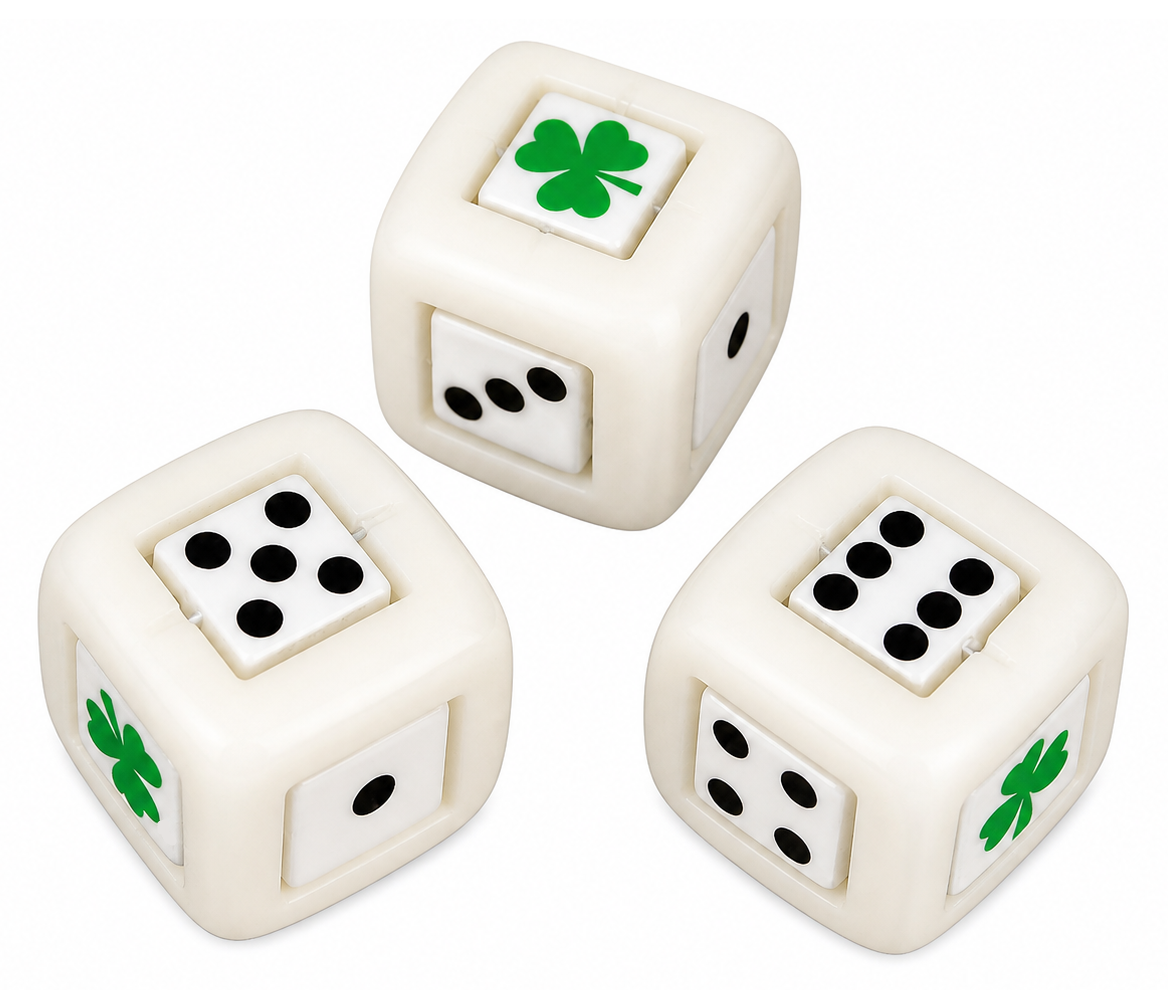
🍀 CloverUp™
Roll smart. Push your luck. Chase the clovers 🍀
👥 Players
2–6 players can play.
🎯 Objective
The goal is to finish the game with the highest total score after 5 rounds.
However, if at any point a player rolls three clovers, they instantly win the entire game.
🧾 Setup
Prepare a simple scoring table before starting the game.
Write player names across the top and rounds (1–5) along the side.
Choose one player to record all scores, and make sure the score table remains visible to everyone throughout the game. This allows players to track their position and decide whether to play safely or take risks.
🔄 Game Structure
The game is played over 5 rounds.
In each round, every player takes one turn. After all players have played, the round ends and a new round begins.
🎲 How a Turn Works
Step 1 – Roll:
Roll all three dice.
Step 2 – Reroll:
You may reroll any number of dice up to two additional times.
After each roll, you may choose which dice to keep and which to reroll.
You may reroll all, some, or none of the dice.
🍀 Each clover you roll gives you one additional reroll.
🚫 Clovers cannot be rerolled. Once rolled, they must be kept for the rest of the turn.
Step 3 – End Turn:
You may stop rolling at any time, or your turn ends when you use all rerolls.
Your final three dice determine your score for the round.
🧮 Scoring (Core of the Game)
At the end of your turn, add together the values of all three dice.
Standard scoring examples:
6 + 4 + 2 = 12 points
5 + 5 + 3 = 13 points
2 + 2 + 1 = 5 points
These simple totals form the base of the game, but clovers can significantly change your result.
🍀 Clover Rules
🍀 One Clover
A single clover guarantees a minimum score of 12 (4,4,4).
If a 5 or 6 appears alongside the clover, all dice become that highest value.
Examples:
Clover + 2 + 3 → 12 points
Clover + 1 + 1 → 12 points
Clover + 5 + 2 → 15 points
Clover + 6 + 1 → 18 points
🍀🍀 Two Clovers
Two clovers automatically give a score of 18 (6,6,6).
You may use remaining rerolls to try for a third clover and win instantly.
🍀🍀🍀 Three Clovers
Instant win! The game ends immediately.
💥 Triple Six Rule
If you roll three natural sixes (6,6,6):
You score 18 points.
All other players who already played in that round score 0 for the round.
The round ends immediately.
Note: This applies only to actual sixes rolled, not results created by clovers.
💥 Double Six Rule
If you roll two sixes (6,6) during your turn:
You may reroll the third die up to 2 additional times to try to roll a third six.
Only the third die may be rerolled, and the two sixes must be kept.
If you roll a third six, apply the Triple Six Rule.
If not, score your final result normally.
Examples:
6,6,3 → You may reroll the 3 up to 2 times trying to get a third 6
6,6,1 → Same situation, reroll the 1
6,6,🍀 → The clover cannot be rerolled, so the Double Six Rule cannot be used. You score 18 points and end your turn.
Note A: If two sixes are rolled on the initial roll, you may have up to 4 total rerolls (2 standard + 2 bonus). Note B: Using all your rerolls of the third die is not a must. If you roll a high number (such as 4 or 5) and you wish to score and end your turn, it is allowed.
🎲 Dice Probability
These dice are designed differently from standard dice.
The numbers are not equally likely:
1 appears most frequently
2 and 3 appear often
4 and 5 appear less often
6 and clover are rare
This means low numbers are common, while high scores require luck or risk-taking.
What this means for your decisions:
Rerolling low numbers (1–3) is often worth the risk.
Keeping a 4 or 5 can be a safer choice.
Rolling a 6 or a clover is powerful, so think carefully before rerolling other dice.
🎯 Example Turns
Example 1 – Standard Play
Roll: 5, 2, 1
Keep 5, reroll others → 5, 4, 2
Score: 11 points
Example 2 – Using a Clover
Roll: Clover, 2, 3
Reroll → Clover, 5, 1
Score becomes 15 points
Example 3 – Two Clovers
Roll: Clover, Clover, 2
Reroll → Clover, Clover, 4
Score: 18 points
Example 4 – Triple Six
Roll: 6, 6, 6
Score: 18 + reset others
🏁 End of the Game
The game ends when either:
A player rolls three clovers and wins instantly,
OR all five rounds are completed.
If no instant win occurred, all players add their scores from all rounds.
The player with the highest total score wins the game.